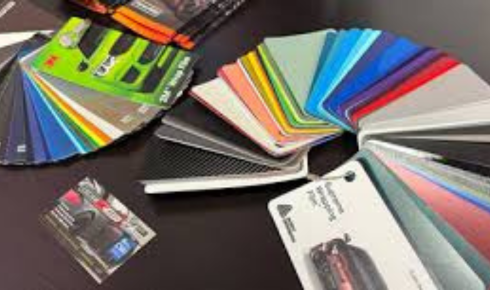
You can tell when a vehicle wrap feels right. Not just looks good — feels right. The way light hits it, the way the surface holds its tone, the way it doesn’t seem to fight the shape of the car or truck underneath.
And if you’ve ever wondered why some wraps age beautifully while others… don’t, the answer usually comes down to something less obvious. Not the design. Not even the installer, at least not entirely.
It’s the material.
The Subtle Language of Finish
Before anyone asks about durability or cost, they usually ask about the finish. Glossy or matte? Something in between? Maybe a texture that adds a bit of personality?
Those choices aren’t just aesthetic — they change how a wrap is experienced.
When people talk about gloss matte finishes, they’re really talking about how a vehicle interacts with light. Gloss reflects, almost like polished paint, giving off that showroom shine. Matte absorbs light, creating a softer, more understated presence. And then there’s satin, quietly bridging the gap.
Each one tells a slightly different story. A glossy finish feels bold, maybe even a little confident. Matte leans more modern, a bit restrained. Neither is better — they just say different things.
What Lies Beneath the Surface
Finish is what we see, but underneath that is where the real decisions happen. Different wrap material types behave differently when applied, when exposed to heat, when stretched across curves.
Some materials are thin and flexible, almost eager to conform to complex shapes. Others are thicker, more rigid, better suited for flatter surfaces or simpler designs.
This isn’t just technical detail — it affects how the wrap looks over time. A material that conforms well will maintain its shape, its alignment. One that struggles might show tension points, slight distortions, edges that don’t sit quite right.
It’s a bit like fabric, in a way. The same pattern can look completely different depending on what it’s printed on.
The Role of Vinyl in the Bigger Picture
Most modern wraps rely on vinyl wrap materials, and for good reason. Vinyl offers a balance that’s hard to beat — flexibility, durability, and a wide range of finishes all in one.
But even within vinyl, there’s variation. Different grades, different manufacturing processes, different adhesive technologies. Some are designed for long-term use, others for shorter-term applications.
The key is matching the material to the purpose. A long-haul commercial vehicle needs something different than a short-term promotional wrap. A heavily curved sports car demands more flexibility than a flat-sided trailer.
And when that match is right, everything else tends to fall into place.
Installation Isn’t Just a Step — It’s a Conversation
One thing people don’t always realize is how much the material influences the installation process. It’s not just about skill (though that matters a lot). It’s about how the material responds.
Some vinyls are forgiving. They allow repositioning, they stretch without distorting, they settle smoothly. Others require a more precise, careful approach — less room for adjustment, more attention to detail from the start.
Installers often talk about “working with” the material rather than “against” it. And that relationship can make all the difference in the final result.
Durability: Where Theory Meets Reality
A wrap might look perfect in a controlled environment. But vehicles don’t live in controlled environments.
They’re out in the sun, exposed to dust, rain, temperature swings. Over time, those factors start to show.
This is where material choice really proves itself. Higher-quality vinyl tends to resist fading, peeling, and cracking. It holds onto its finish, its color, its overall integrity.
Lower-quality options might look fine initially, but they can struggle under those real-world conditions. And once a wrap starts to deteriorate, it’s hard to ignore.
Balancing Cost and Longevity
It’s natural to think about cost upfront. Wrapping a vehicle isn’t a small expense, and the difference between materials can add up.
But it’s rarely just about the initial price. It’s about how long the wrap will last, how well it will maintain its appearance, how often it might need to be replaced or repaired.
In that sense, material choice becomes less about saving money and more about investing it wisely.
A Final Thought
When you look at a well-wrapped vehicle, you’re seeing the result of multiple decisions coming together — design, material, installation, and time.
The material might not be the most visible part of that equation, but it’s one of the most important. It shapes how the wrap behaves, how it ages, how it holds up against everything the road throws at it.
And maybe that’s the quiet truth behind it all. A great wrap isn’t just something you see. It’s something that lasts.